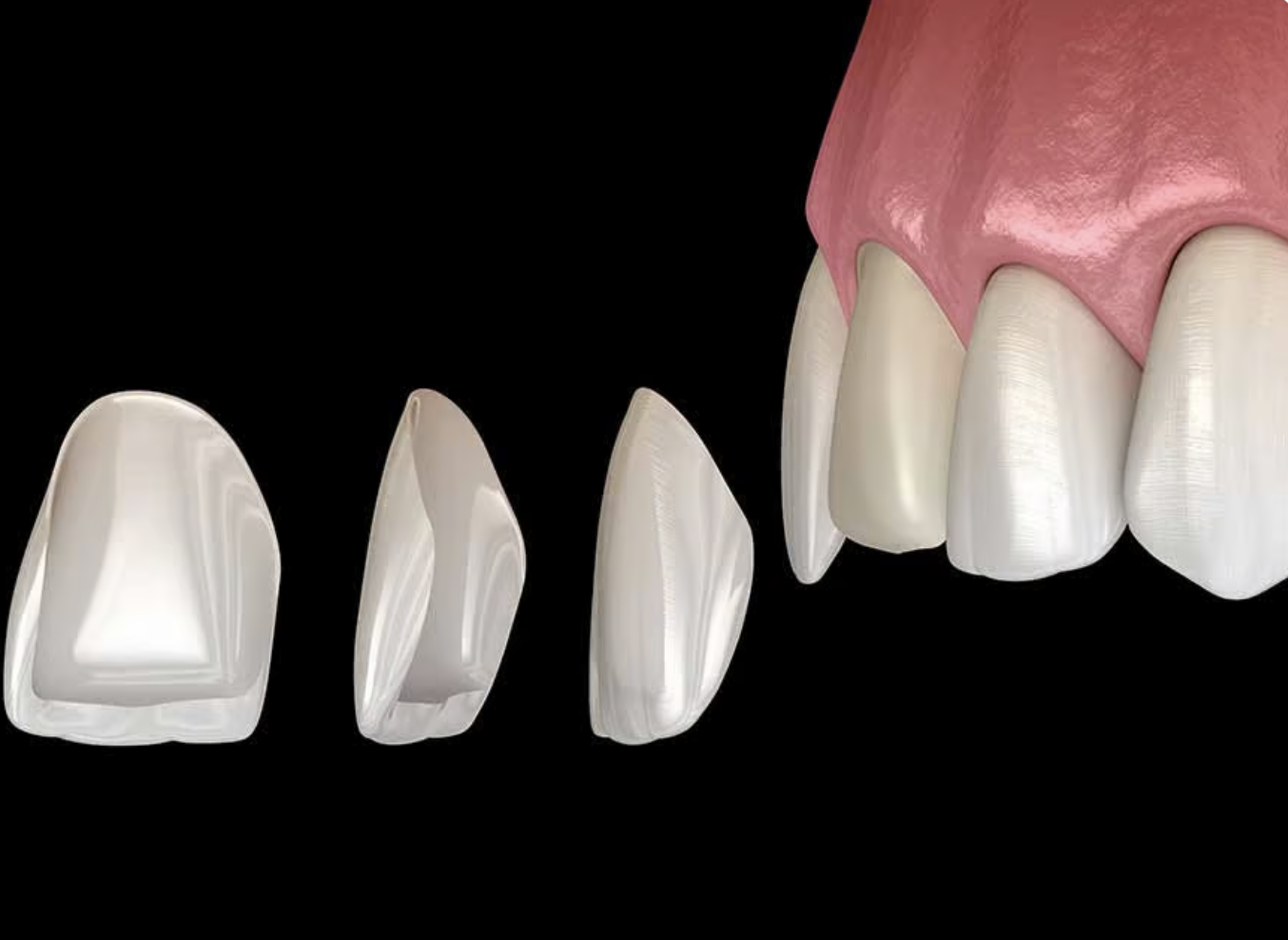
Natural-looking veneers and crowns made from IPS e.max, the lithium disilicate ceramic by Ivoclar. Strong, thin and metal-free, designed digitally from a 3D scan of your teeth and matched to your face, not to a catalogue of "Hollywood" smiles.
4.8★ · 150+ Google reviewsIPS e.max by IvoclarMetal-free ceramic
The basics
Veneers and crowns from one material
Veneers and crowns solve different problems, but at our clinic both are made from the same ceramic: IPS e.max. That means a veneer on a front tooth and a crown next to it have the same translucency and shade, and your smile looks like one natural whole.
Veneer
A thin ceramic shell on the front of the tooth
A veneer covers only the visible front surface of the tooth. E.max veneers can be very thin, from about 0.3 to 0.6 mm, so often only a small amount of enamel needs to be prepared. Veneers change the colour, shape and length of teeth and close small gaps.
Stained teeth that whitening cannot fix
Chipped or worn edges
Small gaps and uneven shapes
Slightly crooked front teeth
Crown
A ceramic cap that covers the whole tooth
A crown covers the tooth from all sides and protects it like a helmet. It is the right choice when a tooth is badly damaged and a veneer would not be strong enough. An e.max crown has no metal inside, so there is no dark line at the gum and light passes through it as through a natural tooth.
Teeth with large fillings or cracks
Teeth after root canal treatment
Broken or heavily worn teeth
Replacing old metal-ceramic crowns
The material
What is IPS e.max
IPS e.max is a lithium disilicate glass-ceramic made by Ivoclar, a dental company from Liechtenstein. It is one of the most widely used materials in aesthetic dentistry because it combines two things that usually contradict each other: strength and natural beauty.
Ordinary glass ceramics look beautiful but are fragile. Metal-ceramic and zirconia restorations are strong but can look opaque. Lithium disilicate sits in between: according to Ivoclar, it has a flexural strength of around 500 MPa, while it lets light pass through and reflect like natural enamel. That is why it is used for both delicate front veneers and crowns that have to withstand chewing.
Strength
Around 500 MPa
High strength for an aesthetic ceramic. It allows thin veneers and crowns that hold up to everyday biting and chewing.
Thin
Veneers from 0.3 mm
Because the material is strong, veneers can be made very thin. That often means less preparation of your natural tooth.
Aesthetics
Lifelike translucency
E.max transmits and scatters light like enamel. It comes in different shades and levels of opacity, so even a darker tooth underneath can be covered naturally.
Metal-free
No metal, no grey line
All-ceramic restorations contain no metal. There is no dark edge at the gum line and no metallic shine through the tooth.
Body-friendly
Biocompatible ceramic
Ceramic is well tolerated by the gums and the body, and its smooth surface resists stains and wear.
Bonding
Bonded to the tooth
Veneers are bonded adhesively, creating a strong, tight connection between the ceramic and the enamel.
How to choose
Veneer or crown?
The decision depends on how much healthy tooth is left. We always prefer the option that keeps more of your natural tooth, and explain honestly why we recommend one or the other.
Veneer
Crown
Covers
The front surface
The whole tooth
Tooth preparation
Minimal, often only enamel
More, from all sides
Best for
Colour, shape, small chips and gaps
Weak, broken or root-treated teeth
Where
Mostly front teeth
Front and back teeth
Material
IPS e.max
IPS e.max
Our approach
Natural, not "Hollywood white"
A good veneer is one nobody notices. We do not sell a flat, paper-white "picture". We design teeth that suit your face, your skin tone and your age: with a living translucent edge, natural shade transitions and the small details that make a smile look real.
Before anything is prepared, we plan the result digitally from a 3D scan of your teeth, so you can discuss the shape and shade in advance.
Cavities and gum inflammation are treated before any veneer or crown.
A professional cleaning, so we see the true shade of your teeth.
If you want lighter teeth overall, we whiten first: ceramic keeps its colour, so we match the veneers to your new shade about two weeks after whitening.
If you grind or clench your teeth, we protect the ceramic with a night guard.
Strongly crooked teeth may be better aligned first, instead of covering them.
If too little healthy tooth is left for a veneer, a crown is the safer choice.
How it works
Your veneers or crowns, step by step
1
Consultation
We examine your teeth and gums, listen to what you would like to change and recommend veneers, crowns or another option.
2
3D scan and digital design
A 3D scan with the Shining 3D Aoralscan Elf replaces impressions. On this model we plan the shape and length of your new teeth.
3
Shade selection
We choose the shade and translucency together with you, in daylight, so the ceramic matches your neighbouring teeth and skin tone.
4
Gentle preparation
Under local anaesthesia, we prepare only as much of the tooth as needed. For veneers this is often a thin layer of enamel.
5
Manufacturing
Your veneers or crowns are made from IPS e.max, based on the digital design.
6
Try-in and bonding
You see the result before final fixing. Then we bond the ceramic to the tooth, check your bite and polish the edges.
After treatment
How to look after veneers and crowns
Ceramic does not decay, but the tooth underneath and the gum around it still need care. With good habits, e.max restorations can serve you for many years.
Daily hygiene
Brush twice a day and clean between teeth with floss or interdental brushes.
No biting hard objects
Do not open bottles, crack nuts or bite pens with your teeth.
Night guard
If you grind your teeth at night, a night guard protects the ceramic.
Regular check-ups
Professional cleaning and a check of the edges at your regular visits.
That is our main goal. We choose the shape, shade and translucency for your face and your other teeth, not a standard "Hollywood" white. E.max transmits light like enamel, so well-made veneers look like your own teeth.
Next step
Book a veneers and crowns consultation
We examine your teeth, take a 3D scan and show you which option suits you.